Skip to content
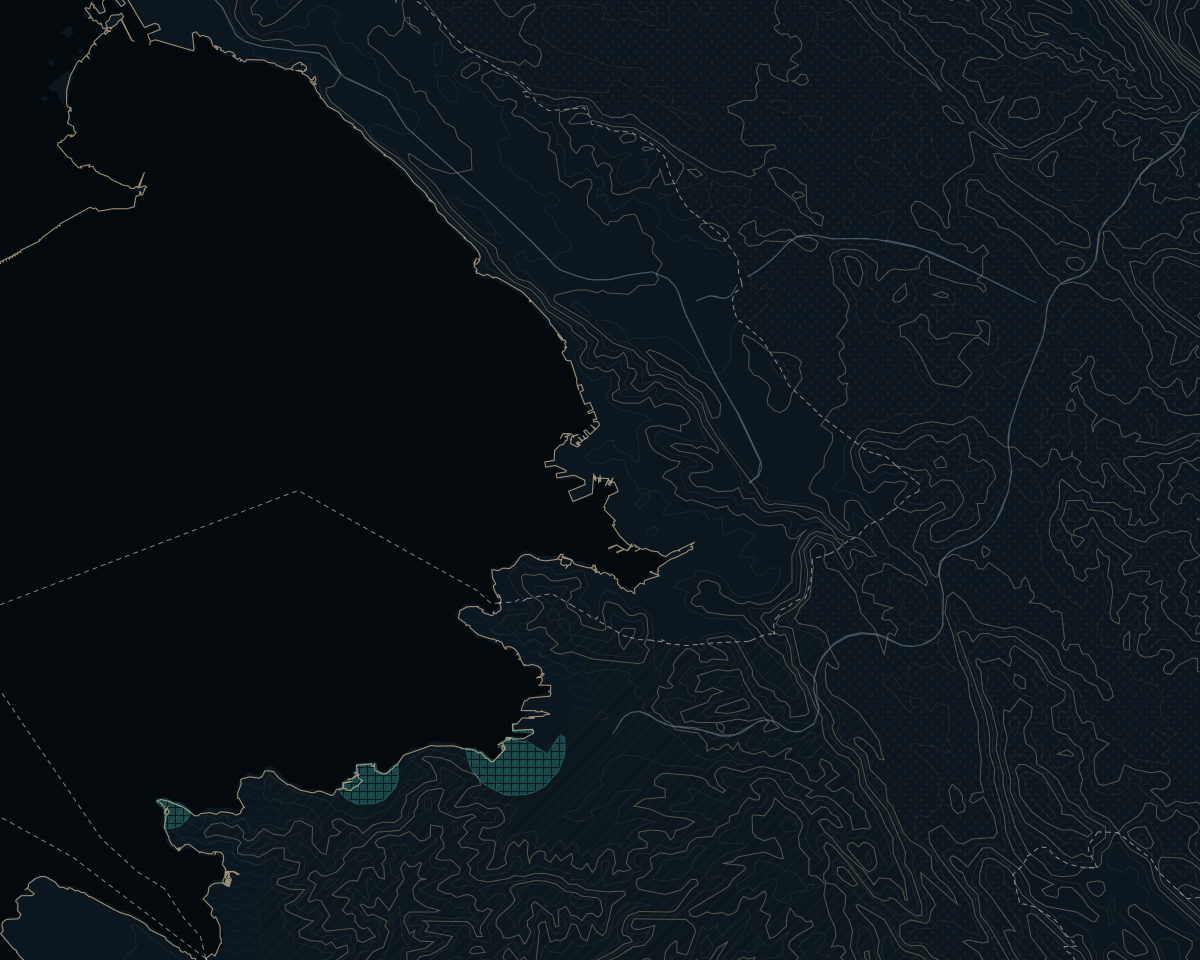
Terrain around Koper, with contour lines
Koper seen across the water from Žusterna at golden hour: the cathedral bell tower, the red roofs of the old town, a stone building with arcades on the waterfront, the white modern buildings on the shore, a red-and-white lattice mast and a crane on the right, sailing boats moored in front; behind, wooded hills.Reworked with AIThe dark stormy sky of the original is replaced by a clear sky with a few high clouds; warm, low golden-hour light on the facades and the bell tower, a light warm haze on the hills, blue sea. The hotel lettering on the roof of the white building was removed; the model had invented other letters on the buildings behind, which were covered locally with nearby pixels (hillside and the building's own band). On the distant hills the model made pylons and buildings more legible than in the original, where they could barely be made out. Bell tower, old town, arcaded building, modern buildings, mast, crane, boats and the outline of the hills are unchanged.
Model
nano_banana_2
Source photo
View of Koper from Zusterna.JPG · Szilas (Wikimedia Commons)
Licence
Public domain
Date
5 October 2026
Its line in the credits
Koper from the water. The golden evening light was recreated with AI.

27 min · 21 km from Piazza Unità d'Italia

Koper: a bilingual Venetian town with a working port

In one sentence

Koper (Capodistria) is the main town of the Slovenian coast, 27 min from Piazza Unità in Trieste without traffic. Its Venetian old town was an island; Italian is an official language, with Italian schools from kindergarten to grammar school. Slovenia's only cargo port begins at the edge of the old town and is part of the view over the bay. Homes are mostly flats, villas sit on the slopes of Žusterna and Semedela, and the public register shows the prices actually signed.

Fact sheet

By car, without traffic
FromDrive timeKilometres
TriestePiazza Unità d'Italia27 min21 km
Munich5 h 26 min507 km
Vienna5 h 11 min484 km
Graz3 h 15 min300 km
Ljubljana72 min107 km

OSRM on OpenStreetMap data, without traffic, measured on 5 October 2026. Arrival and departure at the main square.

Elevation
15 mfrom 1 m to 17 m around the point

EU-DEM (Copernicus): ground elevation, not buildings.

Airports by car
  • Trieste (TRS)57 min
  • Ljubljana (LJU)86 min
  • Portorož (POW)23 minGeneral aviation, no scheduled flights

Distances

Koper and its neighbours

From Koper to the other places, by car
RivieraAnkaran10 min6.7 km
Seaside townsIzola12 min8.1 km
RivieraStrunjan15 min13 km
RivieraPortorož18 min16 km
The KarstKozina23 min26 km
Seaside townsPiran25 min18 km
The KarstDivača27 min34 km
The KarstSežana32 min44 km
The KarstLipica36 min26 km
The KarstTomaj & Dutovlje39 min50 km

Highlighted: the three places most closely linked to this one in our register.

Airports

  • Trieste (TRS)57 min67 kmScheduled flights
  • Ljubljana (LJU)86 min128 kmScheduled flights
  • Venice (VCE)2 h 04 min176 kmScheduled flights
  • Portorož (POW)23 min20 kmGeneral aviation, no scheduled flights

OSRM on OpenStreetMap data, without traffic, measured on 5 October 2026.

All distances, from every starting city

Living here

Living in Koper

An island that became a port town

Koper was an island. The old town stands on a low rise that Venice held from 1279 to 1797; under the Republic it was the main Venetian possession in Istria and lived on trade and salt. A causeway to Semedela came in 1827, and the salt pans around the island, abandoned by 1911, were filled in between 1932 and 1939. Almost everything flat around the old town today is land taken from the sea or the salt pans.

The names carry the history: Aegida in antiquity, then Iustinopolis, traditionally linked to the Byzantine emperor Justin II, then Caput Histriae for the patriarchs of Aquileia, hence Capodistria and Koper. After Venice came Austria, a French interlude, Austria again until 1918, Italy after the Treaty of Rapallo, Zone B from 1945 and, with the London Memorandum of October 1954, Yugoslavia. Most of the town's original population left between 1945 and 1954.

Titov trg holds the Praetorian Palace, once the seat of the Venetian governor and again the town hall since 2001; the cathedral, with works by Vittore Carpaccio; a bell tower that began as a Romanesque watchtower; and the Loggia café. Porta Muda, from 1516, is the only town gate still standing. In September 2025 the restored Collegio dei Nobili reopened as the home of the Italian schools, with the presidents of Slovenia and Italy in attendance.

What sets Koper apart on this coast is that Italian is an official language alongside Slovene, and that it has been a port town since 1957. Luka Koper, the country's only cargo port, begins at the edge of the old town, with the cruise terminal alongside. Koper is a working town all year round, not a resort.

Neighbourhoods: the old town, the slopes, the plain

The town is the former island plus a ring of districts, set apart mainly by height above the sea. The sea-view notes are our estimate from elevation and orientation: check each house.

  • Old town (Staro mesto). Terraced houses and small palazzi; most homes are in buildings from before 1945. Schools, university and beach are all on foot. Views are partial, and the north-east side along Vojkovo nabrežje faces the port. Low points such as Ukmarjev trg flood with very high tides and cloudbursts.
  • Bonifika. Reclaimed land south of the old town: apartment blocks, mostly built since 2010, beside the stadium and the station. Every new flat sold in town since 2024 was here. Little view, no historic character, close to the port and the railway.
  • Semedela. Along the old road on the causeway of 1827: blocks from the 1950s to the 1970s below, where the lower part flooded in November 2019, and terraced and detached houses up the slope.
  • Za gradom and Markovec. Large blocks of the 1970s and 1980s climbing the hill, with terraced houses from around 2000 at the top of Markovec. Views from the upper floors, port included. Parking is short; the municipality is adding spaces.
  • Žusterna. The seafront towards Izola, with beach, coastal park, promenade and water sports centre, and slopes of villas and detached houses, many from around 1970. People from Trieste built holiday villas here from the late nineteenth century. Sea views, cranes included; steep streets.
  • Semedela hill. Villas above Žusterna: the top end of the town's market, with very few sales.
  • Olmo, Prisoje and lower Šalara. Flat inland districts of single-storey terraces from the 1960s and tower blocks from around 1980. Little or no sea view, parts listed as flood-exposed in the zoning plan, and plans for public rental housing and a new primary school on the former Tomos factory site.

Beyond them, from the bilingual hill village of Šalara to Bertoki, Prade, Kampel and Hrvatini, begins another way of living: villages and houses with land among the flysch hills. That world is described in The hills of Koper.

Daily life: the sea, schools, health

The sea is part of the town. The town beach, Mokra mačka, is next to the old town; Žusterna has a beach, water sports and a seafront park with a bay for dogs. Lifeguards are on duty only in summer. The former coast road to Izola, closed to cars, is presented by the tourist board as a beach under construction. Be clear about the water: the gulf is shallow and often turbid, and official data, not recent, put the inner bay of Koper most at risk of eutrophication. For a boat, look to Izola and Portorož: the town marina is small.

Shopping means the Saturday market, the town's shops and the Supernova mall on Ankaranska cesta. Primary care is at the Koper health centre (Zdravstveni dom). Out of hours, on weekday nights and around the clock at weekends and on public holidays, urgent care is at the emergency centre of Izola General Hospital, which stands on Koper's western edge.

Schools are the strong point for Italian-speaking families: the Delfino Blu kindergarten, the Pier Paolo Vergerio il Vecchio primary school, with branches in Semedela, Bertoki and Hrvatini, and the Gian Rinaldo Carli grammar school. The University of Primorska has its seat on Titov trg.

For sport: the Bonifika stadium and sports park, the Žusterna water sports centre, SUP and windsurfing, the Parenzana cycle route and, inland, the climbing crags of the Kraški rob. The cathedral hosts the Koper Organ Festival in autumn, and the MICHELIN Guide 2026 selects Kogo in town and Salicornia in Sermin. Between the town and Bertoki lies Škocjanski zatok, a brackish lagoon protected as a nature reserve.

One limit: the whole municipality is classed as short of water, and in the 2022 drought filling swimming pools was banned.

What there is to buy, and what it costs

Koper is a town of apartments: old-town houses and palazzi; the blocks of Semedela, Za gradom, Markovec and Prisoje; single-storey terraces on the plain. Villas are found mainly on the Žusterna slopes and the Semedela hill. Few homes are in buildings from 2010 or later, and new flats are almost all in Bonifika. GURS, the national surveying authority, notes that old-town buyers mostly want a holiday home or a tourist let.

Slovenia's public sales register (ETN) records the prices actually signed. From 2023 to August 2026, 688 flats sold in the municipality at a median of €4,370/m2 of usable area; median price €230,000, median size 53 m2, middle half of prices between €180,000 and €286,000. In the town itself the median is €4,590/m2. Usable area leaves out walls, balconies and cellars, so the same flat shows more square metres in an Italian listing, which uses commercial area.

Houses: 260 sales in the municipality, median price €250,000, median usable area 80 m2, middle half between €180,000 and €331,000. In town, 79 house sales with a median usable area of 64 m2 and a median price of €275,000. Since 2021, 5 of 444 sales of a single house in the municipality reached seven figures.

A median describes the market, not a house: view, land, parking and condition move a single price far from it. Register prices exclude the 2% transfer tax and include VAT on new builds. On 29 September 2026 the town council also approved a cap, from 2027, on the number of days a year a dwelling can be let for short stays under Slovenia's tourism act (ZGos-1).

Getting here and getting around

From Piazza Unità in Trieste, Koper is 27 min (21 km) without traffic, through the Škofije/Rabuiese crossing. Since January 2026 the coastal expressway needs no Slovenian vignette, a temporary measure until the Koper–Dragonja expressway is built. Ljubljana is 72 min away on the A1, which does need one. Without stops or traffic: Klagenfurt 2 h 13 min, Graz 3 h 15 min, Salzburg 4 h 07 min, Vienna 5 h 11 min, Munich 5 h 26 min.

The border is a line, not a wall, but Italy has run temporary checks on its land border with Slovenia since October 2023; the current notice runs to 18 December 2026.

Scheduled flights: Trieste (TRS), 57 min; Ljubljana (LJU), 86 min; Venice (VCE), 2 h 04 min. Portorož airport, 23 min away, is general aviation, with no scheduled flights.

Koper's railway station has the bus station beside it. Trains to Ljubljana are far slower than the car; the new Divača–Koper line, built mainly for port freight, is in testing, with opening expected between late 2026 and 2027. Arriva buses run several times a day from Trieste's coach station.

By bike, the cycle router puts Izola 25 min away (7.4 km) at e-bike pace, over the Markovec hill. A flat path along the sea, marked in OpenStreetMap as part of the Parenzana route, is shorter; whether it is open and signposted for bikes all the way should be checked on the spot. From Trieste the direct route crosses the industrial zone: for a family, the Delfino Verde ferry to Muggia with the bikes on board, then the climb over the hill, is the better way.

The limits: lorries and freight trains from the port, the transit roads through Škofije, Dekani, Bertoki and Šalara that the 2026 vignette change is meant to relieve, summer queues and too few parking spaces on Markovec.

Real prices

What people actually paid in Koper

Sales recorded by the Slovenian Surveying and Mapping Authority (GURS). Medians are published only with at least fifteen contracts, always with their number and period.
  • HousesKoper (settlement)

    €4,110/m2median per square metre

    middle half €3,670/m2 – €4,650/m2median price €275,000 · median usable area 64 m2n = 79 · 2023 – August 2026 · GURS ETN

  • ApartmentsKoper (settlement)

    €4,590/m2median per square metre

    middle half €3,860/m2 – €5,260/m2median price €230,000 · median usable area 52 m2n = 561 · 2023 – August 2026 · GURS ETN

  • HousesCity Municipality of Koper

    €3,350/m2median per square metre

    middle half €2,320/m2 – €4,110/m2median price €250,000 · median usable area 80 m2n = 260 · 2023 – August 2026 · GURS ETN

  • ApartmentsCity Municipality of Koper

    €4,370/m2median per square metre

    middle half €3,680/m2 – €5,090/m2median price €230,000 · median usable area 53 m2n = 688 · 2023 – August 2026 · GURS ETN

Images

Tito Square in Koper at first light, empty: on the left the stone bell tower of the cathedral with its clock, in the centre a pink building with arcades, on the right the crenellated Praetorian Palace with its outside staircase and loggia.Reworked with AIThe cloudy afternoon sky is replaced by a clear early-morning sky, with low warm light on the facades. Removed: the people in the square (the paving was continued by the model), the shop sign under the arcades and a lattice antenna on a roof behind the pink building; two information boards at the foot of the bell tower, on which the model had invented lettering, were covered locally with the adjacent stone. The lower part of the Praetorian Palace staircase, hidden by people in the original, was reconstructed by the model from the visible trace. Unchanged: bell tower, cathedral, pink building, Praetorian Palace with its windows, arches and battlements, and the low-angle perspective (verticals were not straightened).
Model
nano_banana_2
Source photo
Koper - Zvonik (Mestni stolp) (53634621304).jpg · Fred Romero from Paris, France
Licence
CC BY 4.0
Date
5 October 2026
Its line in the credits
Tito Square, Koper. Early-morning light and the empty square recreated with AI.

If you know Trieste

From Piazza Unità, Koper is as far as Duino: 27 min against 30 min.

Same measure for both: OSRM, without traffic, from Piazza Unità.

Honestly

Is Koper right for you?

Right for you if

  • Those who want a real town all year, with daily life on foot and Italian schools from kindergarten to grammar school.
  • Buyers who want a sea view from a flat rather than a villa, on Markovec or Za gradom, and accept the port in the view.
  • People who work in Trieste and want a full town with services and schools on the Slovenian side, a drive that needs no Slovenian vignette.

Look elsewhere if

  • Those looking for a quiet, unspoilt horizon: the view across the bay includes cranes, cruise ships and port works.
  • Those who want a boat berth below the house: the town marina is small, and Izola and Portorož are the places for boats.
  • Those who want a detached house with land: in town such houses rarely change hands, and the hills of Koper suit that wish better.

Questions

Questions

Is Italian spoken in Koper?

Italian is an official language in the town and in the surrounding bilingual settlements listed in Article 7 of the municipal statute, among them Bertoki, Hrvatini, Šalara and Škocjan. Place names and public signs are in both languages, and there are Italian schools from kindergarten to grammar school. That is an institutional presence, not a guarantee: most residents speak Slovene day to day, and the villages of the hinterland lie outside the bilingual area.

Does a sea view in Koper mean a view of the port?

From Žusterna, Markovec and the Semedela slopes it usually does: these slopes look north across the bay of Koper, and the port occupies the opposite shore. That is our estimate from elevation and orientation, to be checked house by house. Pile-driving for the extension of the port's first pier runs on weekdays until December 2026, with completion planned for the end of 2027; the port says the noise can be heard along parts of the coast but stays within limits.

Does Koper flood?

Parts of it do. On 12 November 2019 the sea reached its second-highest level since 1961 and covered the seafront, lower Semedela, Ukmarjev trg and the underpasses; a cloudburst flooded old-town streets in August 2023. The 2024 draft of the municipal zoning plan lists among exposed areas the reclaimed land of Semedela and Bonifika, Šalara, Olmo, the Badaševica valley and low seafront spots such as Ukmarjev trg. Check the specific plot against the plan before buying.

How much does a flat in Koper cost?

In Slovenia's public sales register, flats in the municipality sold from 2023 to August 2026 at a median of €4,370/m2 of usable area, with a median price of €230,000; in the town itself the median is €4,590/m2. Usable area is net of walls and balconies, so compare it with care against Italian listings. These are signed prices, not asking prices, and not a figure for any particular home.

Do I need a Slovenian vignette to drive from Trieste to Koper?

No. Since 1 January 2026 the former coastal expressways H5 and H6 are toll-free state roads for cars, a temporary measure until the Koper–Dragonja expressway is completed. The A1 towards Ljubljana, and the A3 from Trieste towards Sežana and Divača, still require a vignette.

Can SloveniaVillas help me buy property in Koper, or sell it?

Not yet. Today we do not broker in Slovenia and we do not introduce buyers to sellers. We plan to start during 2027 with licensed local agencies handling the legal and administrative side, while TriesteVillas brings marketing and international promotion. We have already analysed homes in the hills of Koper at their owners' request. Until then, this page, the guides and the calculators are free to use.

Private Collection

Let me know when homes in Koper come in

Today we have no homes in Slovenia: we start during 2027, and those on the list hear first.

Put me on the list

Sources

OSRM times assume free-flowing traffic and are usually ten to twenty per cent shorter than real driving; on the coast in summer they can double.