Skip to content
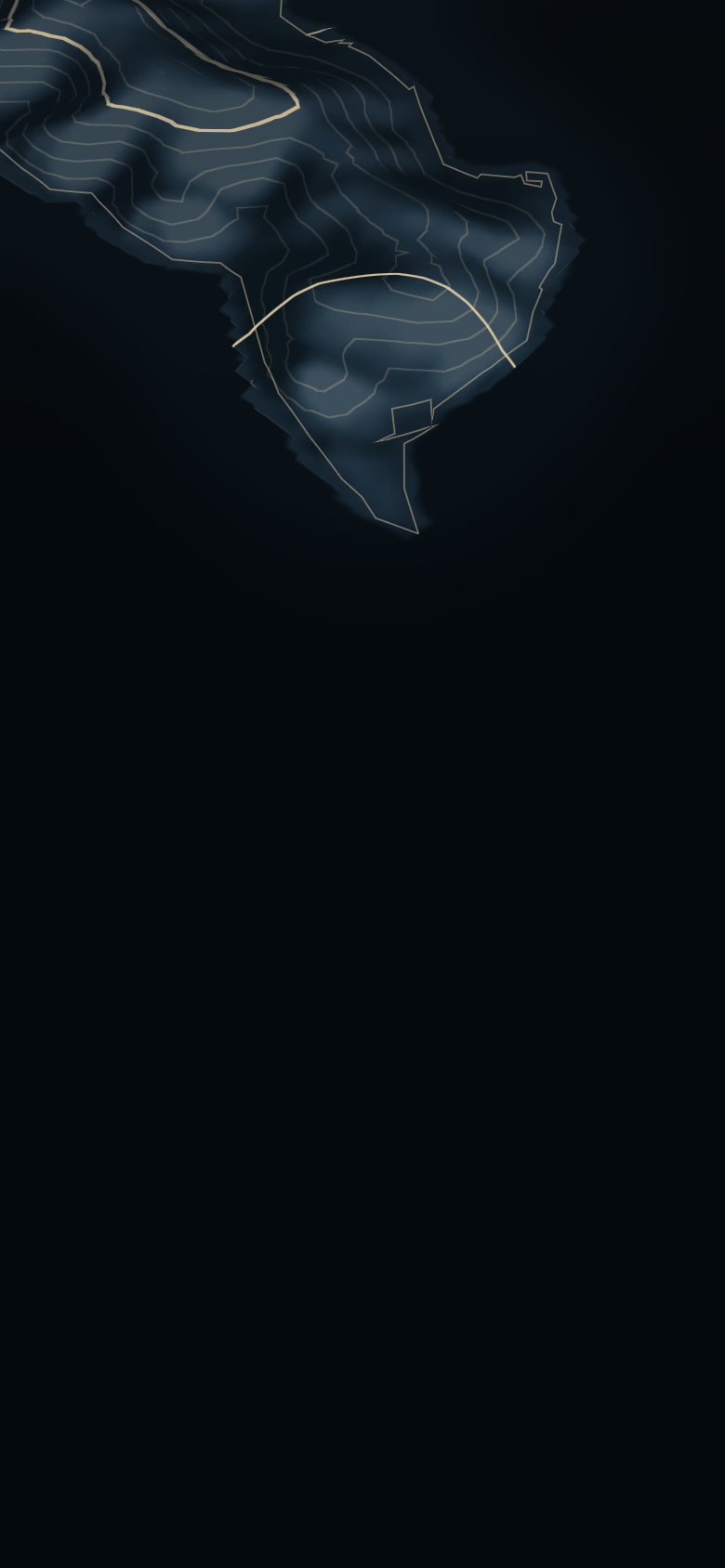
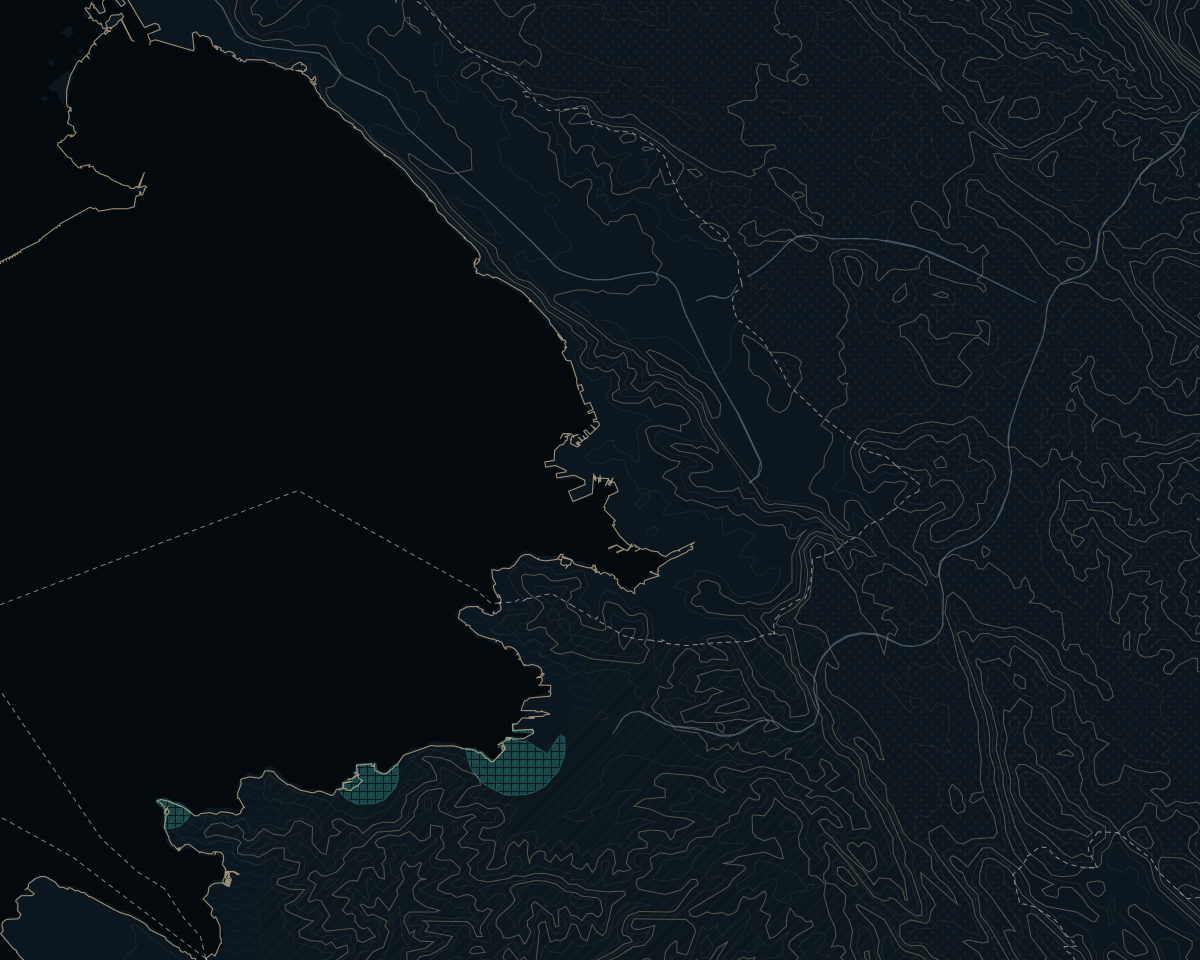
Terrain around Piran, with contour lines
Piran from above at sunset: the peninsula with the red roofs of the old town, Tartini Square with the town hall, on the ridge to the right the church of St George with its bell tower and baptistery, another bell tower and the trees of the hill in the foreground; the open sea lit by the low sun.Reworked with AIThe midday light of the original becomes a sunset from the west: warm raking light on roofs and bell towers, long shadows, a warm sky at the horizon, a golden sheen on the sea; the trees in the foreground look warmer. The model removed the sailing boats and a motorboat's wake from the sea and the people on the path up to St George's. Framing, horizon, the shape and length of the peninsula, the roofs, the town hall, Tartini Square, St George's church with the baptistery and the other bell towers are unchanged. A first attempt that lowered the horizon and shortened the peninsula was discarded.
Model
nano_banana_2
Source photo
View over Piran from City Walls - Piran - Adriatic Coast - Slovenia - 02 (54567125624).jpg · Adam Jones from Kelowna, BC, Canada
Licence
CC BY 2.0
Date
5 October 2026
Its line in the credits
Piran from the walls. The sunset light was recreated with AI.

45 min · 36 km from Piazza Unità d'Italia

Piran: buying and living in the old Venetian town

In one sentence

Piran is the Venetian town at the western tip of the Slovenian coast: an oval square on a filled-in harbour, streets closed to visitors' cars, salt pans on either side. It is 45 min from Trieste without traffic. Flats in the old town are small and old, sold at a median €4,760/m2 of useful area; the costly houses stand on the hills. The trade-offs: high water in the square, summer crowds, parking at the edge.

Fact sheet

By car, without traffic
FromDrive timeKilometres
TriestePiazza Unità d'Italia45 min36 km
Munich5 h 44 min523 km
Vienna5 h 29 min499 km
Graz3 h 33 min316 km
Ljubljana1 h 30 min122 km

OSRM on OpenStreetMap data, without traffic, measured on 5 October 2026. Arrival and departure at the main square.

Elevation
7 mfrom 1 m to 62 m around the point

EU-DEM (Copernicus): ground elevation, not buildings.

Airports by car
  • Trieste (TRS)75 min
  • Ljubljana (LJU)1 h 44 min
  • Portorož (POW)17 minGeneral aviation, no scheduled flights

Distances

Piran and its neighbours

From Piran to the other places, by car
RivieraPortorož9 min3.5 km
RivieraStrunjan12 min6.4 km
Seaside townsIzola19 min11 km
Seaside townsKoper26 min19 km
RivieraAnkaran31 min25 km
The KarstKozina41 min41 km
The KarstDivača45 min49 km
The KarstSežana50 min59 km
The KarstLipica53 min41 km
The KarstTomaj & Dutovlje57 min65 km

Highlighted: the three places most closely linked to this one in our register.

Airports

  • Trieste (TRS)75 min82 kmScheduled flights
  • Ljubljana (LJU)1 h 44 min143 kmScheduled flights
  • Venice (VCE)2 h 22 min192 kmScheduled flights
  • Portorož (POW)17 min9.4 kmGeneral aviation, no scheduled flights

OSRM on OpenStreetMap data, without traffic, measured on 5 October 2026.

All distances, from every starting city

Living here

Living in Piran

A salt town at the tip of the peninsula

Piran sits at the end of a narrow peninsula, a Venetian town of tight streets that visitors may not drive into. It belonged to the Venetian Republic until its fall in 1797, and it grew on salt: its salt pans are documented from the year 804, and at Lera, in the Sečovlje park south-east of town, salt is still harvested by hand.

The centre is Tartini Square, an oval laid over the old inner harbour, which was filled in 1894 for reasons of hygiene. The bronze of the violinist Giuseppe Tartini, born here in 1692, went up in 1896; the paving is a design by Boris Podrecca from 1992. On the square stands the Benečanka, a fifteenth-century Venetian Gothic palace. On the hill above the roofs stands the church of St George, its Venetian-style bell tower crowned by the archangel Michael; the town walls have towers open to visitors; the lighthouse at the Punta dates from the nineteenth century and stands on a fortification of 1617. A tradition links the name to the Greek pyr, fire, for the signal fires once lit here.

The municipality's official name is bilingual, Občina Piran / Comune di Pirano, and in its nationally mixed area Italian is an official language alongside Slovene. Until the end of the Second World War the town was largely Italian-speaking; most of that population left in the decade after 1945, in the exodus from Istria, and the Italian community is based today at Casa Tartini, the composer's birthplace.

The limits are part of the character. The old town has been losing residents since 2011 while the rest of the municipality grows, and its population is older than the municipal average. In summer it fills with visitors: the municipality takes the largest share of tourist nights on the Slovenian coast, with Austrians and Germans ahead of Italians among foreign guests.

The old town, the hill and the rest of the municipality

The old town. Between Tartini Square, the Punta and the hill of St George, the character and the constraints are at their densest. Whether a flat sees the sea depends on the street and the floor: in the narrow inner streets, check it on the spot. The lowest parts flood: on 12 November 2019, during the second-highest tide measured at Koper since 1961, Tartini Square went under water, and on 31 May 2024 a cloudburst flooded the square and several premises. There is no car at the door.

The hill and the walls. The walls and the area above Razgled climb to about 62 m from a square almost at sea level: whoever lives up there walks up.

Fornače and Fiesa. Fornače, on the side towards Portorož, has the main car park and a town lido. Fiesa is a small bay below the cliff on the way to Strunjan, with shallow water, pines and two small lakes left by the clay pits of a former brickworks; the tourist board describes one of them as the only brackish lake in Slovenia. The footpath from Piran to Fiesa was closed by a landslide in May 2024 and again in September 2026, for unstable slopes after rain.

Bernardin. The strip between Piran and Portorož is hotels and a congress centre, not a residential district; what it gives a resident is the seafront walk.

The rest of the municipality. Portorož, the spa and resort town, and Strunjan, inside its landscape park, have their own pages. Lucija, the most populous place in the municipality, has blocks from the 1980s and 1990s, newer semi-detached houses, shops, workshops and the marina next door; sea views are partial. Seča, on its own small peninsula, is green and quiet, with the oldest population in the municipality and the Forma viva sculpture park. Sečovlje lies between the salt pans, the airfield and the Croatian border, and looks over the pans rather than the open sea. The inland villages of Padna, Sveti Peter, Nova vas nad Dragonjo and Dragonja belong to the same municipality, away from the sea.

Living in Piran: sea, services, health, schools

The sea is at the end of the street, but it is not a sandy beach. The town lidos at the Punta and at Fornače are concrete and stone, with gravel in places; Fiesa has shallow water and pines; the nearest sand is the central beach of Portorož. Several beaches in the municipality, from Bernardin to Strunjan, have held the Blue Flag in recent years.

Everyday life. Inside the walls it means cafés, a market and the sea a few streets away. Outside them, the municipality describes Lucija as grown from a dormitory district into an area of shops and trades.

Health. The municipal health centre (Zdravstveni dom Piran) has its main building in Portorož and surgeries on the Piran quay and at Sečovlje; the nearest hospital with an emergency department is the General Hospital in Izola. Two limits: the health centre runs an extra family-medicine surgery for patients without an assigned doctor, a sign that not everyone finds one; and while a roundabout is being built at Belveder, weekend jams slow the road to Izola, so the municipality and the health centre keep an extra emergency team on duty at weekends until the works are finished.

Schools. Alongside the Slovene-language system, the bilingual coast has Italian-language state schools; the Ginnasio Antonio Sema, the Italian-language grammar school, is in Portorož/Piran. We have found no IB or international school on the Slovenian coast; the International School of Trieste is across the border.

Sport and culture. Marina Portorož, the first marina in Slovenia (1974), lies between Portorož and Lucija; the sailing club in Portorož runs regattas into late October; kite-surfers use the cape at Seča; guided dives and sea kayaking are offered from Piran. The Tartini Festival brings concerts to town from late August into September, the town has the Maritime Museum and an Aquarium, and Stara Gostilna and Srebrna vilica are listed in the MICHELIN Guide Slovenia.

Piran property: what sells and at what price

Three kinds of home make up the market. In the old town, small flats in historic buildings, most of them dated in the register, often conventionally, to 1900 or earlier; in Lucija, flats in blocks from the 1970s to the 1990s; on the hills of Portorož, above Piran and at Strunjan, the houses that form the expensive end.

In the official register of sales (GURS), the municipality recorded 310 flat sales over 2023 – agosto 2026: median €4,560/m2 of useful area, middle half between €3,750/m2 and €5,630/m2, median price €205,000 for 46 m2. In the town of Piran itself, 124 sales at a median €4,760/m2 for a median size of only 39 m2: a high price per square metre, a low price per flat (€175,000). A large share of the most recent contracts is still being checked by GURS.

Houses: 90 sales, median price €428,000, middle half between €242,000 and €702,000; in Portorož, on a small number of sales, the median is €788,000. GURS writes that the coast's most expensive houses traditionally sell here; for flats that is not true every year. Since 2021, 18 of 159 house sales reached a million euros or more.

A median is the middle of a mixed sample, not the price of a house. Useful area leaves out balconies, terraces, cellars and garages, and register prices exclude the 2% transfer tax. In buildings this old, have a surveyor check the structure, ask the heritage office what a restoration allows, and ask whether a parking space or permit comes with the flat.

Getting there and getting around

Routing software gives 45 min from Trieste to Tartini Square without traffic. In practice it takes longer: the old town is largely closed to traffic, cars stop at the garages on the edge, and the last stretch is a minibus or a walk. From Ljubljana it is 1 h 30 min, from Klagenfurt 2 h 31 min, from Graz 3 h 33 min, from Salzburg 4 h 25 min, from Vienna 5 h 29 min and from Munich 5 h 44 min, without traffic or stops. Since 1 January 2026 the expressway from the border at Škofije towards Izola needs no vignette for cars, as a temporary measure. The Italy–Slovenia border is a line, not a wall, but since 2023 Italy has notified temporary checks, currently until 18 December 2026.

By air: scheduled flights use Trieste (75 min), Ljubljana (1 h 44 min) and Venice (2 h 22 min). Portorož airport, 17 min away at Sečovlje, is general aviation with no scheduled flights.

Without a car: local buses link Piran, Portorož, Lucija and Strunjan, with a minibus from the garages to Tartini Square. The nearest railway station is Koper, with buses on to Piran. In summer a fast boat crosses from Trieste; in winter there is none. By bike, the seafront to Portorož is 2.9 km, about 10 min; from there the Parenzana trail runs through the Valeta tunnel to Strunjan and Izola.

The limits: parking is paid by the hour; in summer the coast road and the approaches to Portorož fill up; and when the Slovenian government dropped the vignette on the coastal expressway, it cited congestion from through traffic in Izola and Lucija.

Real prices

What people actually paid in Piran

Sales recorded by the Slovenian Surveying and Mapping Authority (GURS). Medians are published only with at least fifteen contracts, always with their number and period.
  • HousesPiran (settlement)

    €6,230/m2median per square metre

    middle half €4,500/m2 – €8,620/m2median price €500,000 · median usable area 91 m2n = 15 · 2023 – August 2026 · GURS ETN

  • ApartmentsPiran (settlement)

    €4,760/m2median per square metre

    middle half €3,920/m2 – €5,800/m2median price €175,000 · median usable area 39 m2n = 124 · 2023 – August 2026 · GURS ETN

  • HousesMunicipality of Piran

    €4,900/m2median per square metre

    middle half €3,330/m2 – €7,590/m2median price €428,000 · median usable area 80 m2n = 90 · 2023 – August 2026 · GURS ETN

  • ApartmentsMunicipality of Piran

    €4,560/m2median per square metre

    middle half €3,750/m2 – €5,630/m2median price €205,000 · median usable area 46 m2n = 310 · 2023 – August 2026 · GURS ETN

Honestly

Is Piran right for you?

Right for you if

  • People who want to live on foot, with the sea, cafés and concerts within a few streets, and who accept a small flat without a car at the door.
  • Buyers of a second home with history, for whom the setting counts for more than floor area.
  • Sailors and spa-goers who want Marina Portorož and the Portorož spas a short ride away, with the old town as home base.

Look elsewhere if

  • Families with two cars, or anyone who needs to park at the door every day.
  • Anyone looking for space and a garden at a moderate price: flats in the old town are small, and houses on the hills sell at the top of the coast's range.
  • Buyers counting on letting to tourists all year: under the tourism law, from 2027 letting days in Piran are capped, by municipal ordinance or by the law itself.

Questions

Questions

Can foreigners buy a house in Piran, Slovenia?

Citizens and companies of EU, OECD and EFTA countries buy in Slovenia on the same terms as Slovenians, with no reciprocity procedure: Germans, Austrians, Italians, Swiss, British and Americans all fall in this group. Citizens of EU candidate countries need a reciprocity decision from the Ministry of Justice; citizens of other countries cannot buy, except by inheritance and then subject to reciprocity.

How much does a flat in Piran cost?

In the official register (GURS), flats sold in the town of Piran over 2023 – agosto 2026 went for a median €4,760/m2 of useful area, with a median size of 39 m2 and a median price of €175,000. The median is the middle sale of a mixed sample, not the price of a given flat, and useful area leaves out balconies, terraces and cellars.

Is Piran the most expensive place on the Slovenian coast?

For houses, yes: GURS writes in its 2024 and 2025 reports that the coast's most expensive houses traditionally sell in Piran and Portorož. For flats, no: the highest median for used flats was in Koper in 2024 and in Ankaran, on a small sample, in 2025.

Can I let a flat in Piran to tourists?

Under the tourism law in force since 1 January 2026 (ZGos-1, UL 77/2025), the property must be entered in the national register of accommodation kept by AJPES, and its number must appear in every listing. Piran is on the list of municipalities where short lets are considered high-risk, so from 2027 letting days are capped: the council can set its own cap by ordinance, otherwise the default in the law applies. The council was due to vote on a proposal on 6 October 2026, and private individuals face a ceiling of their own. Check the ordinance in force and the registration before you buy, and do not count on letting all year.

Does the old town flood?

Sometimes. On 12 November 2019, during the second-highest tide measured at Koper since 1961, Tartini Square went under water; on 31 May 2024 a cloudburst flooded the square and several premises. For a ground-floor or waterfront property, ask the seller about past flooding and look at the walls with a surveyor.

How do I get from Trieste to Piran without a car?

Arriva buses run from Trieste bus station to Koper, where buses continue to Portorož and Piran; the nearest railway station is also in Koper. In summer a fast boat (Liberty Lines) crosses directly from Trieste to Piran; it does not run in winter.

Photo essay

Piran in pictures

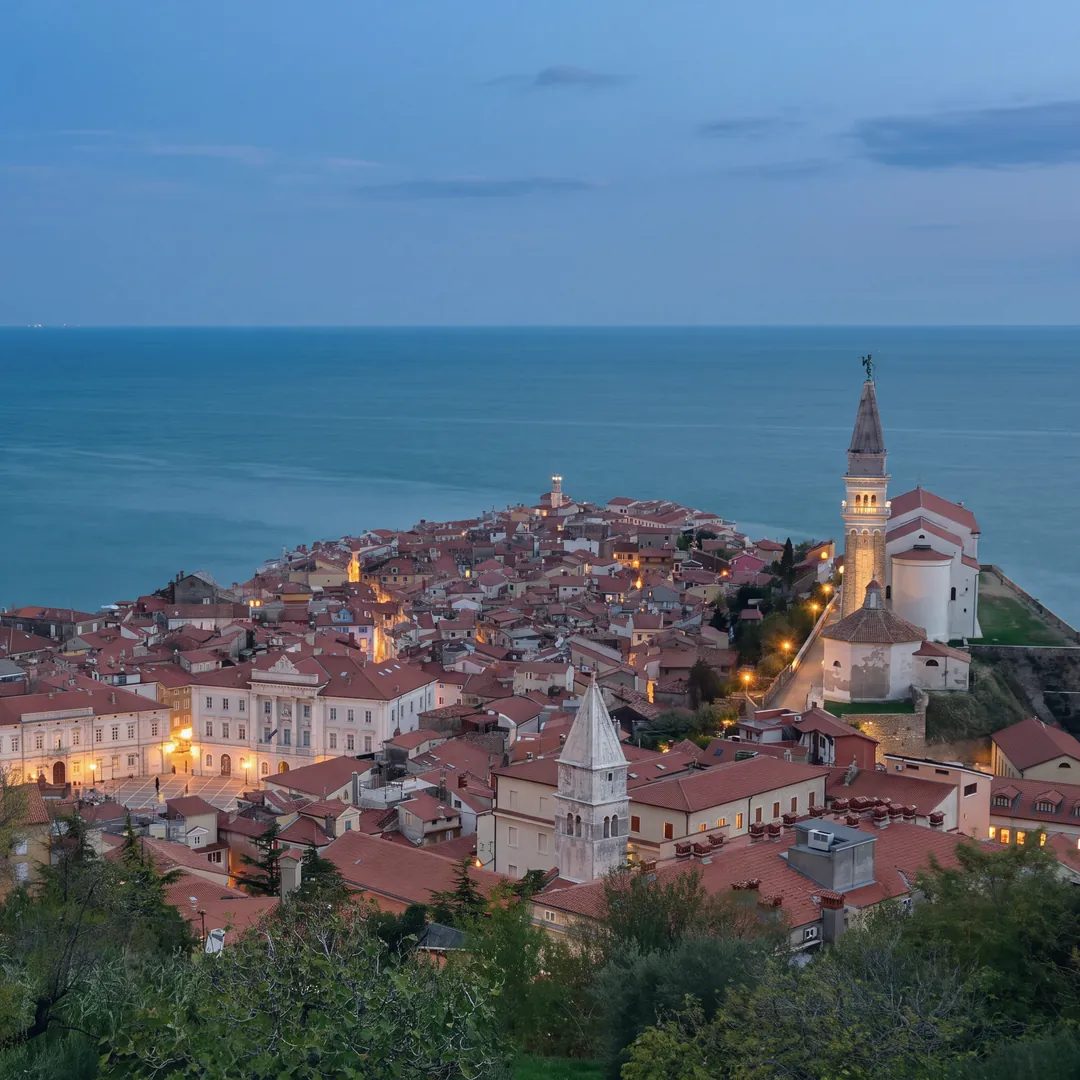
Piran from above at blue hour, from the hill of the town walls: the red roofs of the old town down to the tip, Tartini Square with the town hall and the first street lamps lit, on the right the church of St George with its lit bell tower and the octagonal baptistery, another bell tower in the foreground; beyond, the open sea.Reworked with AIThe grey, windy day of the original, with a choppy sea, becomes blue hour: blue sky with a few clouds, calm sea, street lamps and some windows lit in the town and around Tartini Square, St George's bell tower floodlit. On the bell tower the model had drawn a clock face that is not visible in the original: it was covered locally with masonry from the same tower. Roofs, town hall, St George's church with the baptistery, the tip, the walls and the trees are unchanged; the people were already distant and unrecognisable.
Model
nano_banana_2
Source photo
A view of Piran form the old city walls (8134812747).jpg · Boštjan Rudolf from Koper, Slovenia
Licence
CC BY 2.0
Date
5 October 2026
Its line in the credits
Piran at blue hour. The evening light and the lit lamps were recreated with AI.

Private Collection

Let me know when homes in Piran come in

Today we have no homes in Slovenia: we start during 2027, and those on the list hear first.

Put me on the list

Sources

OSRM times assume free-flowing traffic and are usually ten to twenty per cent shorter than real driving; on the coast in summer they can double.